World Book
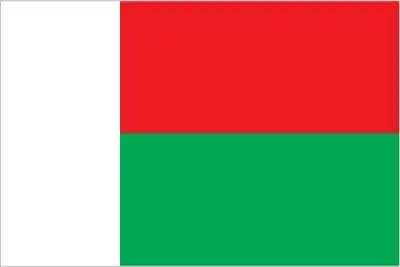
Madagascar
World Book Index
45

With a score of 45, the country is ranked 145th out of 158 countries in the World Book ranking. (more information)
Introduction
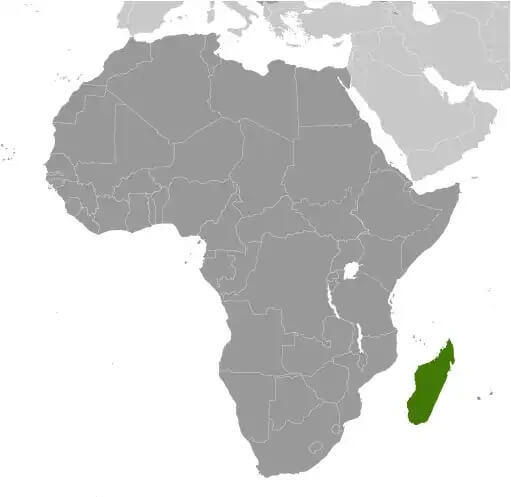
Madagascar, an island nation located off the southeastern coast of Africa, is renowned for its unique biodiversity and rich cultural heritage. It was one of the last major habitable landmasses on Earth to be settled by humans, which has contributed to its distinctive flora and fauna. Historically, Madagascar served as a pirate stronghold during the late 17th and early 18th centuries, a testament to its strategic maritime significance. The island was colonized by the French in 1896, leading to a prolonged period of colonial rule until it regained independence in 1960. Today, Madagascar stands as a vibrant nation, grappling with the challenges of development while striving to preserve its unparalleled natural environment.
Neighboring countries
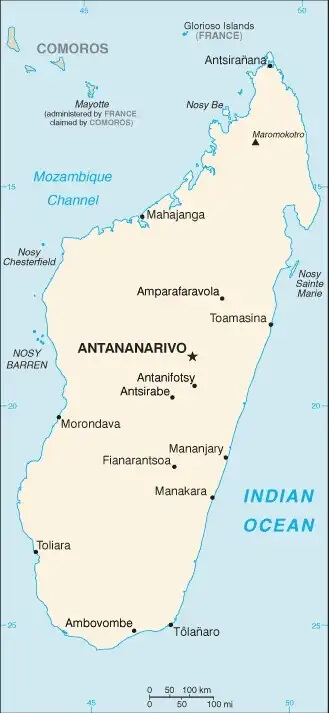
Comoros - France - Mauritius - Mozambique - Seychelles
Geography
Area
Total: 587,041 sq km
Land: 581,540 sq km
Water: 5,501 sq km
Climate
The climate of Madagascar is characterized by a tropical climate along the coast, transitioning to a temperate climate inland, and becoming arid in the southern regions. This diverse climatic range contributes to the island's rich biodiversity and varying ecosystems.
Natural resources
Madagascar is endowed with a wealth of natural resources, including graphite, chromite, coal, bauxite, rare earth elements, salt, quartz, tar sands, semiprecious stones, mica, fish, and hydropower. These resources play a crucial role in the country's economy and development prospects.
People and Society
Population
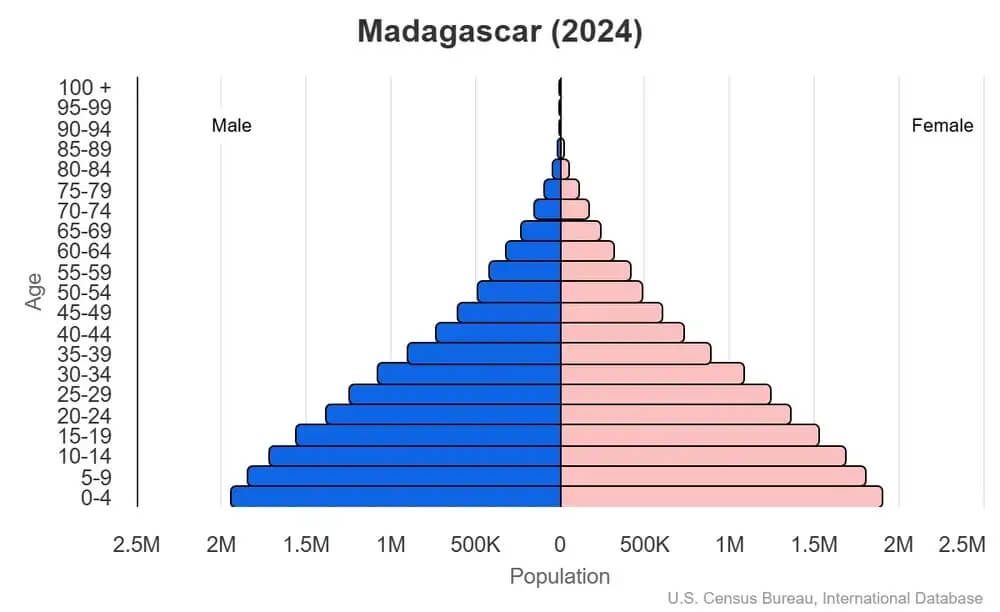
Total: 29,452,714 (2024 estimated)
Ethnic groups
The population of Madagascar is ethnically diverse, primarily consisting of Malayo-Indonesian groups such as the Merina and related Betsileo. Additionally, there are Cotiers, who are of mixed African, Malayo-Indonesian, and Arab ancestry, including the Betsimisaraka, Tsimihety, Antaisaka, and Sakalava. The island is also home to French, Indian, Creole, and Comoran communities, reflecting its complex historical interactions and migrations.
Languages
The official language is Malagasy, spoken by 99.9% of the population. French is also an official language, spoken by 23.6%, while English is spoken by 8.2% of the population, highlighting the country's colonial history and ongoing global connections. Other languages account for 0.6% (2018 estimated).
Religions
The religious landscape of Madagascar is predominantly Christian, with the Church of Jesus Christ in Madagascar/Malagasy Lutheran Church/Anglican Church comprising 34% of the population. Roman Catholics make up 32.3%, while other Christian denominations account for 8.1%. Traditional beliefs and Animism are practiced by 1.7%, and Muslims represent 1.4%. A significant portion of the population, 21.9%, identifies as having no religion (2021 estimated).
Population growth rate
The population growth rate is estimated at 2.18% (2024 estimated), indicating a youthful demographic that presents both opportunities and challenges for the country's development.
Government
Government type
Madagascar operates as a semi-presidential republic, which combines elements of presidential and parliamentary systems, allowing for a distribution of power between the executive and legislative branches.
Capital
Name: Antananarivo
Executive branch
The chief of state is President Andry RAJOELINA, who has been in office since 16 December 2023. The head of government is Prime Minister Christian NTSAY, serving since 6 June 2018, who plays a crucial role in the administration of government policies and programs.
Diplomatic representation in the US
The chief of mission is Ambassador Lantosoa RAKOTOMALALA, who has been serving since 13 January 2025, representing Madagascar's interests in the United States.
Diplomatic representation from the US
The chief of mission is Ambassador Claire PIERANGELO, who has been in position since 2 May 2022, facilitating diplomatic relations between the United States and Madagascar.
Economy
Economic overview
Madagascar's economy is classified as a low-income East African island economy, characterized by its rich natural resources and significant challenges, including extreme poverty. The return of political stability has fostered economic growth, although the COVID-19 pandemic resulted in a sharp decline in tax revenues. The country is notably the leading producer of vanilla, which is a key export commodity, but it also faces environmental fragility that threatens its economic sustainability.
Real GDP (purchasing power parity)
$52.968 billion (2024 estimated)
$50.833 billion (2023 estimated)
$48.782 billion (2022 estimated)
Real GDP per capita
$1,700 (2024 estimated)
$1,600 (2023 estimated)
$1,600 (2022 estimated)
Exports
$4.689 billion (2022 estimated)
$3.362 billion (2021 estimated)
$2.589 billion (2020 estimated)
Exports - partners
USA 16%, France 15%, Japan 8%, China 6%, S. Korea 6% (2023)
Exports - commodities
The primary export commodities include garments, nickel, vanilla, cloves, and gold (2023), which are vital to the country's trade balance and economic health.
Imports
$6.041 billion (2022 estimated)
$4.769 billion (2021 estimated)
$3.718 billion (2020 estimated)
Imports - partners
The main import partners are China 19%, Oman 13%, France 10%, India 8%, and South Africa 5% (2023), reflecting Madagascar's reliance on foreign goods and services.
Imports - commodities
Key import commodities include refined petroleum, rice, fabric, cotton fabric, and wheat (2023), which are essential for meeting the needs of the population and supporting economic activities.
Human Development Index
The country's Human Development Index (HDI) is 0.487, ranking it 183th out of 193 countries tested. (more information)
World Happiness Report
The World Happiness Report ranked the country 133rd out of 158 countries tested with a score of 4.186. (more information)