World Book
South Africa
World Book Index
63

With a score of 63, the country is ranked 95th out of 158 countries in the World Book ranking. (more information)
Introduction
South Africa, a nation rich in history and cultural diversity, has undergone significant transformations since the arrival of Bantu-speaking groups around A.D. 500. The Dutch traders who landed at the southern tip in 1652 marked the beginning of European influence, which intensified when the British seized the Cape of Good Hope in 1806. The complex interplay of British and Afrikaner (Dutch descendants) governance from 1910 to 1961 laid the groundwork for the struggle against apartheid, led by the African National Congress (ANC). The landmark multi-racial elections of 1994 symbolized the end of apartheid and ushered in a new era of democracy and inclusivity for the nation.
Neighboring countries
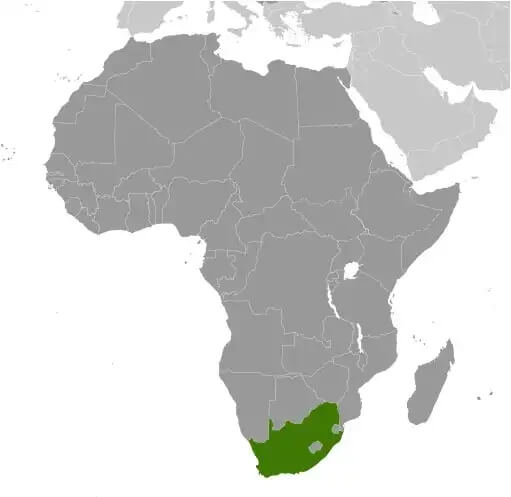
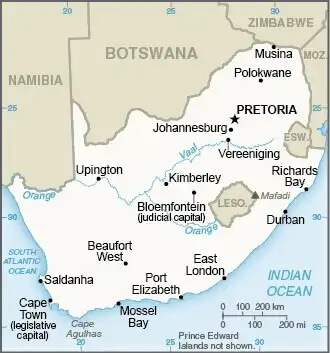
Botswana - Eswatini - Lesotho - Mozambique - Namibia - Zimbabwe
Geography
Area
Total: 1,219,090 sq km
Land: 1,214,470 sq km
Water: 4,620 sq km
South Africa's geography is characterized by its vast and varied landscapes, which include coastal regions, plateaus, and mountain ranges. The country is predominantly semiarid, with a subtropical climate along the eastern coast. This climatic diversity contributes to the rich biodiversity found within its borders, making it a unique ecological zone. The nation is endowed with abundant natural resources, including gold, chromium, antimony, coal, iron ore, manganese, nickel, phosphates, tin, rare earth elements, uranium, gem diamonds, platinum, copper, vanadium, salt, and natural gas, which play a crucial role in its economy and global trade.
People and Society
Population
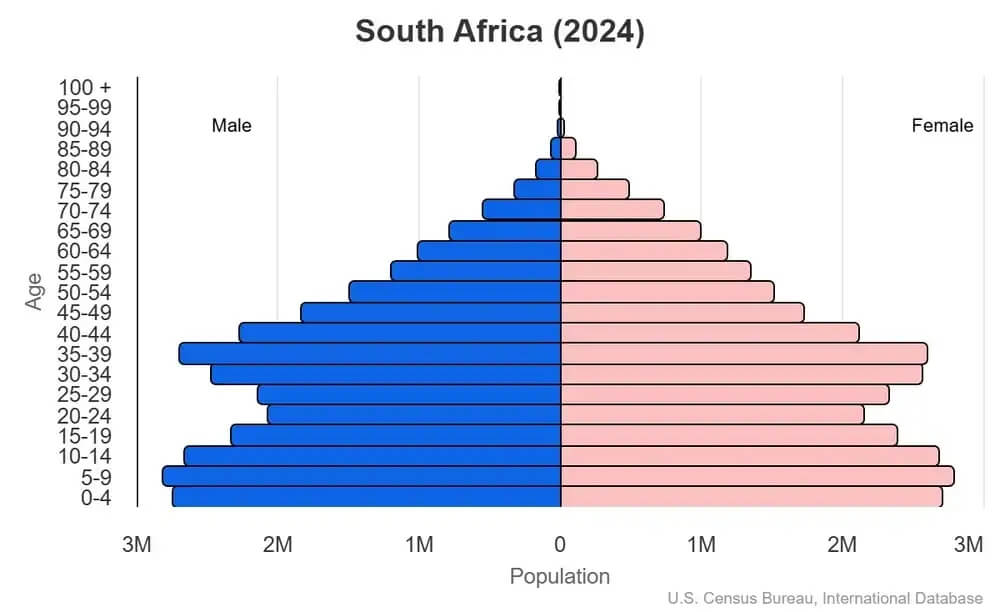
Total: 60,442,647 (2024 estimated)
Ethnic groups
Black African 80.9%, Colored 8.8%, White 7.8%, Indian/Asian 2.6% (2021 estimated)
Languages
isiZulu or Zulu (official) 25.3%, isiXhosa or Xhosa (official) 14.8%, Afrikaans (official) 12.2%, Sepedi or Pedi (official) 10.1%, Setswana or Tswana (official) 9.1%, English (official) 8.1%, Sesotho or Sotho (official) 7.9%, Xitsonga or Tsonga (official) 3.6%, siSwati or Swati (official) 2.8%, Tshivenda or Venda (official) 2.5%, isiNdebele or Ndebele (official) 1.6%, other (includes South African sign language (official) and Khoi or Khoisan or Khoe languages) 2% (2018 estimated)
Religions
Christian 86%, ancestral, tribal, animist, or other traditional African religions 5.4%, Muslim 1.9%, other 1.5%, nothing in particular 5.2% (2015 estimated)
Population growth rate
1.07% (2024 estimated)
The demographic landscape of South Africa is marked by its rich tapestry of ethnicities and languages, reflecting the country's complex history. With a population exceeding 60 million, the majority are Black Africans, followed by significant Colored, White, and Indian/Asian communities. The linguistic diversity is equally striking, with eleven official languages, showcasing the nation's commitment to multiculturalism. Religion plays a pivotal role in the lives of many South Africans, with Christianity being the predominant faith. However, traditional African religions also hold significant cultural importance. The population growth rate of 1.07% indicates a gradual increase, which presents both opportunities and challenges for the nation in terms of resource allocation and social services.
Government
Government type
Parliamentary republic
Capital
Name: Pretoria (administrative capital); Cape Town (legislative capital); Bloemfontein (judicial capital)
Executive branch
Chief of state: President Matamela Cyril RAMAPHOSA (since 19 June 2024)
Head of government: President Matamela Cyril RAMAPHOSA (since 19 June 2024)
Diplomatic representation in the US
Chief of mission: Ambassador (vacant); Chargé d’Affaires Ismail ESAU (since 17 March 2025)
Diplomatic representation from the US
Chief of mission: Ambassador (vacant); Chargé d’Affaires David J. GREENE (since March 2025)
South Africa operates as a parliamentary republic, characterized by a multi-tiered governance structure that includes an executive, legislative, and judicial branch. The capital cities are strategically divided among Pretoria, Cape Town, and Bloemfontein, each serving distinct governmental functions. The current leadership under President Matamela Cyril Ramaphosa, who has been in office since June 2024, faces the ongoing challenge of navigating the complexities of governance in a diverse society while addressing pressing national issues.
Economy
Economic overview
Upper-middle-income, largest southern African economy; Government of National Unity facing slow growth, fiscal gaps, and structural challenges; high income inequality, unemployment, and poverty; reforms to address electricity generation, transport, and logistics; leading producer and exporter of critical minerals
Real GDP (purchasing power parity)
$870.42 billion (2024 estimated)
$865.402 billion (2023 estimated)
$859.399 billion (2022 estimated)
Real GDP per capita
$13,600 (2024 estimated)
$13,700 (2023 estimated)
$13,800 (2022 estimated)
Exports
$127.629 billion (2024 estimated)
$124.671 billion (2023 estimated)
$136.01 billion (2022 estimated)
Exports - partners
China 19%, USA 8%, Germany 7%, India 7%, UK 6% (2023)
Exports - commodities
gold, platinum, coal, cars, iron ore (2023)
Imports
$119.59 billion (2024 estimated)
$123.454 billion (2023 estimated)
$127.669 billion (2022 estimated)
Imports - partners
China 21%, India 7%, USA 7%, Germany 6%, UAE 4% (2023)
Imports - commodities
refined petroleum, crude petroleum, gold, cars, broadcasting equipment (2023)
Human Development Index
The country's Human Development Index (HDI) is 0.741, ranking it 106th out of 193 countries tested. (more information)
World Happiness Report
The World Happiness Report ranked the country 91st out of 158 countries tested with a score of 5.316. (more information)