World Book
Trinidad and Tobago
World Book Index
69

With a score of 69, the country is ranked 65th out of 158 countries in the World Book ranking. (more information)
Introduction
Trinidad and Tobago, a twin-island nation located in the Caribbean, boasts a rich history shaped by its colonial past and diverse cultural influences. Initially colonized by the Spanish, the islands transitioned to British control in the early 19th century, which significantly impacted their socio-economic landscape. The introduction of contract laborers from India between 1845 and 1917 not only transformed the sugar industry but also laid the groundwork for a vibrant cocoa sector. The discovery of oil on Trinidad in 1910 marked a pivotal moment, establishing petroleum as a crucial export and economic driver. Achieving independence in 1962, Trinidad and Tobago has since navigated its path as a sovereign nation, embracing its multicultural identity and economic potential.
Neighboring countries
Barbados - Grenada - Guyana - Venezuela
Geography
Area
Total: 5,128 sq km
Land: 5,128 sq km
Water: 0 sq km
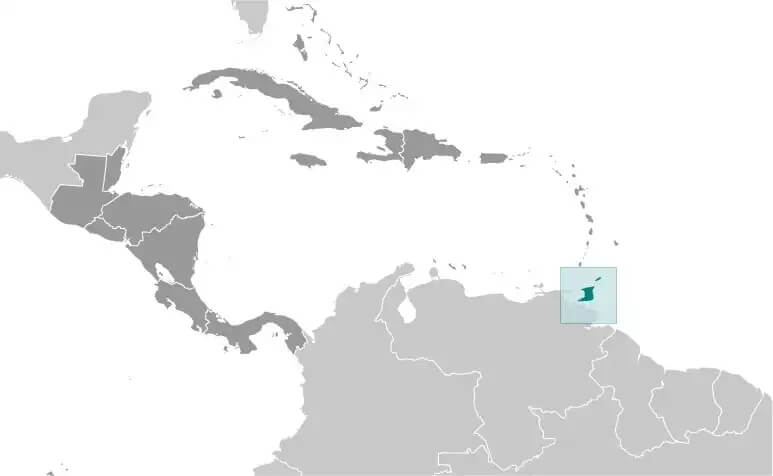
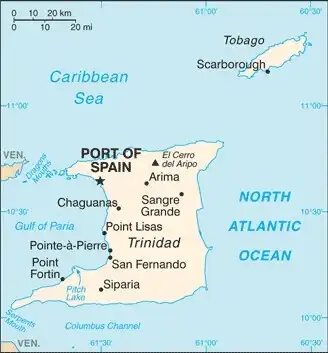
The geography of Trinidad and Tobago is characterized by its unique positioning at the southernmost tip of the Caribbean, just off the coast of Venezuela. The islands feature a diverse landscape that includes lush rainforests, mountainous regions, and coastal plains. The climate is predominantly tropical, with a distinct rainy season occurring from June to December, which influences the local ecosystem and agriculture. The natural resources of the islands are significant, particularly petroleum and natural gas, which play a vital role in the economy. Additionally, asphalt is another notable resource, contributing to the country's industrial activities and exports.
People and Society
Population
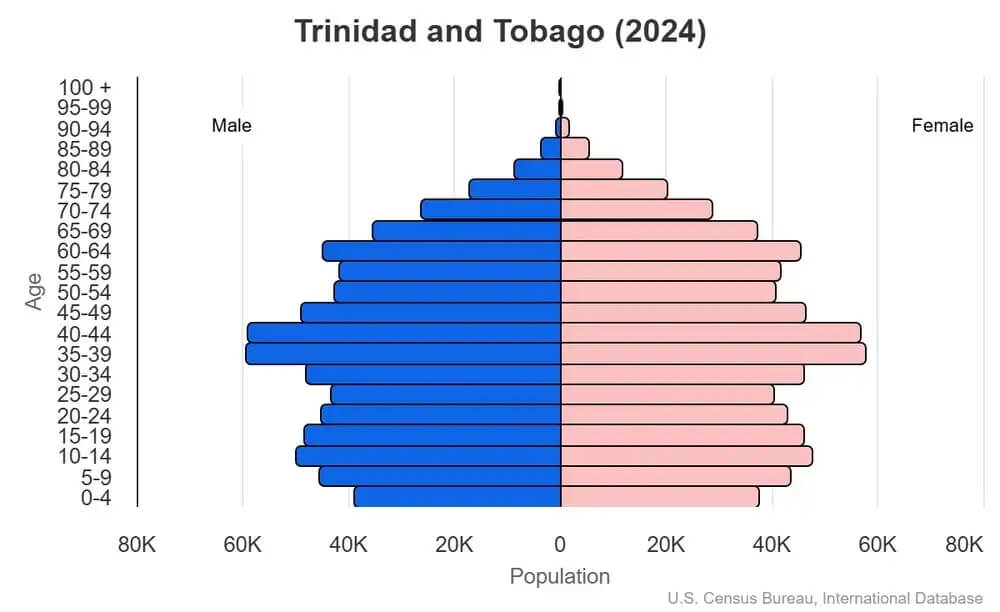
Total: 1,408,966 (2024 estimated)
Trinidad and Tobago is home to a diverse population that reflects a rich tapestry of ethnic backgrounds and cultural traditions. The demographic composition includes East Indian (35.4%), individuals of African descent (34.2%), and various mixed groups, showcasing the islands' multicultural heritage. The linguistic landscape is equally varied, with English as the official language, complemented by Trinidadian Creole English, Tobagonian Creole English, Caribbean Hindustani, and other dialects. This linguistic diversity is a testament to the islands' historical interactions and cultural exchanges. In terms of religion, the population is predominantly Protestant (32.1%), followed by Roman Catholic (21.6%), Hindu (18.2%), and Muslim (5%), illustrating a broad spectrum of beliefs and practices. The population growth rate remains modest at 0.1% (2024 estimated), indicating a stable demographic environment.
Government
Government type
Parliamentary republic
Capital
Name: Port of Spain
The government of Trinidad and Tobago operates as a parliamentary republic, where the President serves as the head of state and the Prime Minister as the head of government. Currently, President Christine KANGALOO has been in office since 20 March 2023, while Prime Minister Kamla Susheila PERSAD-BISSESSAR took office on 1 May 2025. This political structure allows for a democratic process where elected representatives govern on behalf of the citizens. The country maintains diplomatic relations with various nations, including the United States, where the chief of mission is currently a vacant ambassador position, with Chargé d'Affaires Venessa RAMHIT-RAMROOP serving since 4 June 2025.
Economy
Economic overview
Trinidad and Tobago presents a high-income Caribbean economy, distinguished by its role as a major hydrocarbon exporter. The economy is bolstered by key sectors such as tourism and finance, which contribute significantly to its GDP. However, the country faces challenges, including high inflation rates and a growing public debt, which necessitate careful economic management. Additionally, there are long delays in accessing foreign currency, although the nation benefits from large foreign reserves and a sovereign wealth fund that provide a buffer against economic fluctuations.
Real GDP (purchasing power parity)
$43.362 billion (2024 estimated)
$42.658 billion (2023 estimated)
$42.058 billion (2022 estimated)
Real GDP per capita
$31,700 (2024 estimated)
$31,200 (2023 estimated)
$30,800 (2022 estimated)
Exports
$11.087 billion (2024 estimated)
$11.545 billion (2023 estimated)
$17.584 billion (2022 estimated)
Exports - partners
USA 28%, China 7%, Guyana 5%, Chile 5%, Netherlands 5% (2023)
Exports - commodities
Natural gas, alcohols, ammonia, crude petroleum, iron reductions (2023)
Imports
$10.19 billion (2024 estimated)
$9.219 billion (2023 estimated)
$10.968 billion (2022 estimated)
Imports - partners
USA 29%, Guyana 27%, China 8%, Brazil 4%, Canada 3% (2023)
Imports - commodities
Railway cargo containers, refined petroleum, cars, iron ore, excavation machinery (2023)
Human Development Index
The country's Human Development Index (HDI) is 0.807, ranking it 72nd out of 193 countries tested. (more information)
World Happiness Report
The World Happiness Report ranked the country 68th out of 158 countries tested with a score of 5.905. (more information)