World Book
Uzbekistan
World Book Index
66

With a score of 66, the country is ranked 82th out of 158 countries in the World Book ranking. (more information)
Introduction
Uzbekistan stands as a pivotal nation in Central Asia, serving as both a geographic and demographic hub of the region. Since gaining independence from the Soviet Union in 1991, Uzbekistan has embarked on a transformative journey, marked by significant economic diversification. The country has made strides in enhancing its agricultural sector, particularly in cotton production, while simultaneously expanding its mineral and petroleum exports. With a youthful population, Uzbekistan is poised for growth and development, leveraging its rich cultural heritage and strategic location to foster regional cooperation and economic partnerships.
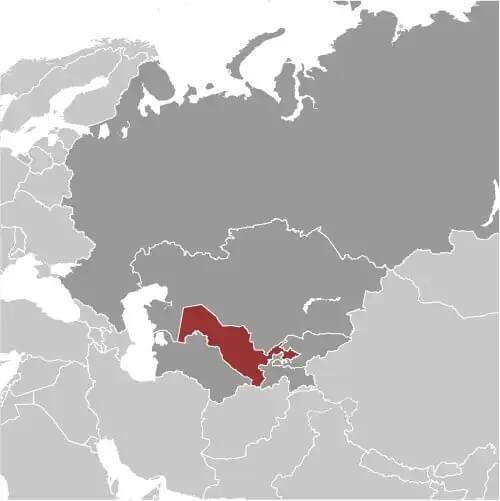
Neighboring countries
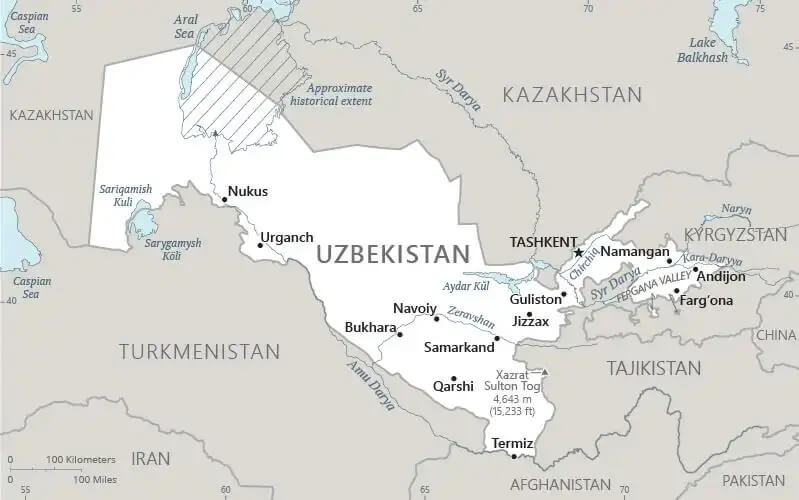
Afghanistan - Kazakhstan - Kyrgyzstan - Tajikistan - Turkmenistan
Geography
Area
Total: 447,400 sq km
Land: 425,400 sq km
Water: 22,000 sq km
Uzbekistan's geography is characterized by its vast expanses of land, predominantly consisting of desert and semi-arid regions. The country is situated in the heart of Central Asia, bordered by five nations, which enhances its strategic significance. The climate is primarily mid-latitude desert, featuring long, hot summers and mild winters, with a semiarid grassland region located in the east. This diverse climatic condition supports a variety of ecosystems and agricultural practices, making Uzbekistan a vital player in the region's agricultural output. The country is endowed with substantial natural resources, including natural gas, petroleum, coal, gold, uranium, silver, copper, lead, zinc, tungsten, and molybdenum, which are crucial for its economic development and energy security.
People and Society
Population
Total: 36,520,593 (2024 estimated)
Ethnic groups
Uzbek 83.8%, Tajik 4.8%, Kazakh 2.5%, Russian 2.3%, Karakalpak 2.2%, Tatar 1.5%, other 2.9% (2017 estimated)
Languages
Uzbek (official) 74.3%, Russian 14.2%, Tajik 4.4%, other 7.1%
Religions
Muslim 88% (mostly Sunni), Eastern Orthodox 9%, other 3%
Population growth rate
1.43% (2024 estimated)
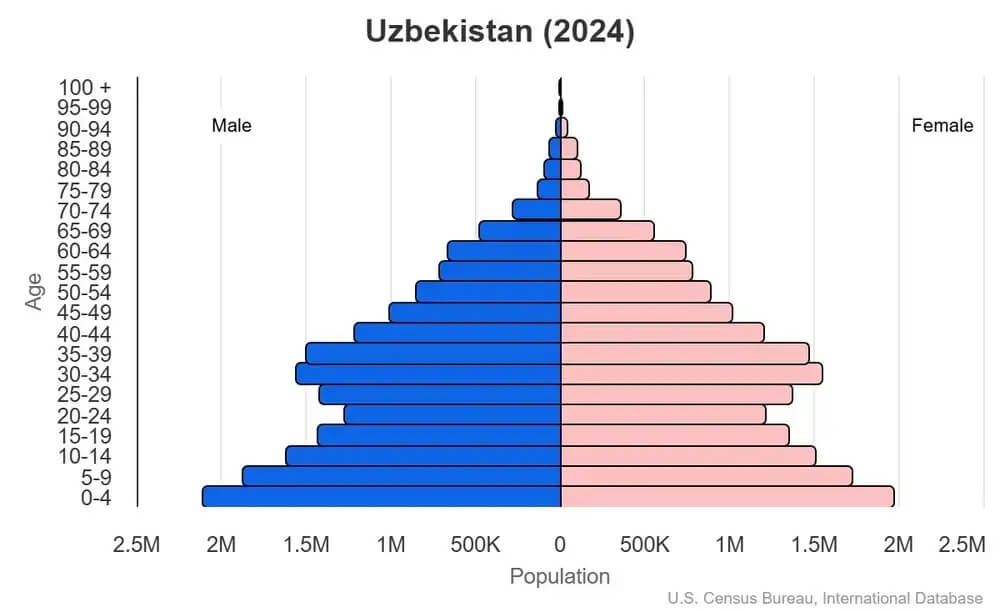
Uzbekistan's population is a tapestry of ethnic diversity, with Uzbeks forming the majority at 83.8%. The country is home to several minority groups, including Tajiks, Kazakhs, and Russians, contributing to a rich cultural mosaic. The official language is Uzbek, reflecting the national identity, while Russian and Tajik are also widely spoken, indicating the historical influences in the region. The predominant religion is Islam, with a significant majority identifying as Sunni Muslims. The population growth rate of 1.43% suggests a youthful demographic, which presents both opportunities and challenges for the nation in terms of education, employment, and social services. As Uzbekistan continues to modernize, the interplay of its diverse cultural and social fabric will play a crucial role in shaping its future.
Government
Government type
Presidential republic; highly authoritarian
Capital
Name: Tashkent (Toshkent)
Executive branch
Chief of state: President Shavkat MIRZIYOYEV (since 14 December 2016)
Head of government: Prime Minister Abdulla ARIPOV (since 14 December 2016)
Diplomatic representation in the US
Chief of mission: Ambassador Furqat SIDIKOV (since 19 April 2023)
Diplomatic representation from the US
Chief of mission: Ambassador Jonathan HENICK (since 14 October 2022)
Uzbekistan operates as a presidential republic, characterized by a highly authoritarian governance structure. The capital city, Tashkent, serves as the political and administrative center of the country. The executive branch is led by President Shavkat Mirziyoyev, who has been in office since December 2016, alongside Prime Minister Abdulla Aripov. The government has been noted for its centralized control and limited political pluralism, which shapes the political landscape and influences the country's domestic and foreign policies.
Economy
Economic overview
Lower-middle income Central Asian economy; key exporter of natural gas, cotton, and gold; ongoing reform efforts to reduce state-owned sector dominance, attract foreign investment, and improve sustainability of cotton production
Real GDP (purchasing power parity)
$379.989 billion (2024 estimated)
$356.797 billion (2023 estimated)
$335.678 billion (2022 estimated)
Real GDP per capita
$10,500 (2024 estimated)
$10,000 (2023 estimated)
$9,600 (2022 estimated)
Exports
$26.173 billion (2024 estimated)
$25.05 billion (2023 estimated)
$20.966 billion (2022 estimated)
Exports - partners
Switzerland 34%, Russia 12%, UK 11%, China 7%, Turkey 6% (2023)
Exports - commodities
Gold, cotton yarn, garments, fertilizers, fabric (2023)
Imports
$43.624 billion (2024 estimated)
$42.646 billion (2023 estimated)
$35.643 billion (2022 estimated)
Imports - partners
China 32%, Russia 17%, Kazakhstan 8%, S. Korea 6%, Turkey 5% (2023)
Imports - commodities
Cars, vehicle parts/accessories, packaged medicine, refined petroleum, aircraft (2023)
Uzbekistan's economy is classified as a lower-middle-income economy, with a strong reliance on key exports such as natural gas, cotton, and gold. The government is actively pursuing reforms aimed at reducing the dominance of the state-owned sector, which has historically constrained economic growth. Efforts are underway to attract foreign investment, particularly in sectors that promise sustainable development, such as cotton production, which is a significant part of the economy. The country's real GDP, measured in purchasing power parity, is projected to reach $379.989 billion in 2024, reflecting a steady growth trajectory. The GDP per capita is also on the rise, expected to reach $10,500 in 2024. Uzbekistan's trade dynamics reveal a diverse export portfolio, with Switzerland, Russia, and the UK being major partners, while imports are heavily sourced from China and Russia. This economic landscape presents both challenges and opportunities as Uzbekistan navigates its path towards modernization and integration into the global economy.
Human Development Index
The country's Human Development Index (HDI) is 0.740, ranking it 107th out of 193 countries tested. (more information)
World Happiness Report
The World Happiness Report ranked the country 75th out of 158 countries tested with a score of 5.816. (more information)