World Book
Tajikistan
World Book Index
60

With a score of 60, the country is ranked 99th out of 158 countries in the World Book ranking. (more information)
Introduction
Tajikistan, a landlocked country in Central Asia, boasts a rich history that intertwines with the broader narrative of the region. The Tajik people came under Russian imperial rule in the 1860s and 1870s, marking the beginning of significant geopolitical changes. In 1929, the USSR designated Tajikistan as a separate republic, a pivotal moment that shaped its national identity. Following the dissolution of the Soviet Union in 1991, Tajikistan emerged as an independent nation, embarking on a journey of self-determination and development. Today, it stands as a testament to resilience, navigating the complexities of post-Soviet transition while embracing its cultural heritage and aspirations for the future.
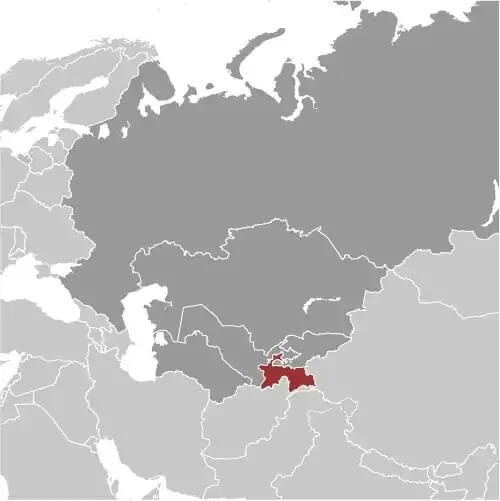
Neighboring countries
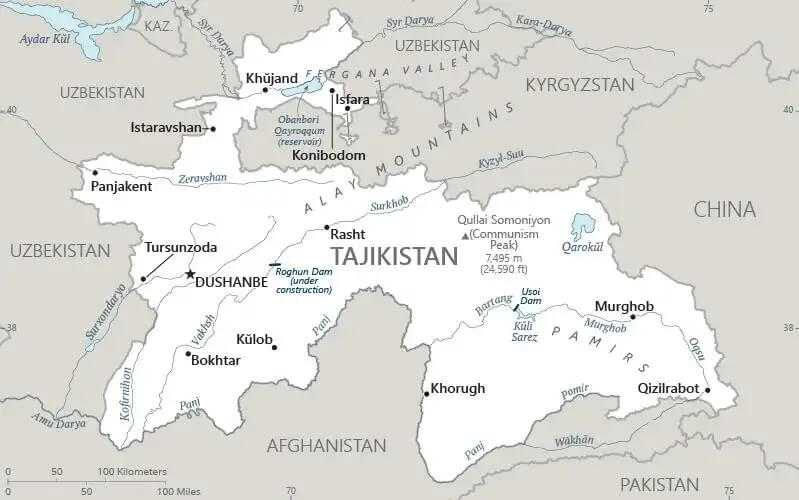
Afghanistan - China - Kyrgyzstan - Pakistan - Uzbekistan
Geography
Area
Total: 144,100 sq km
Land: 141,510 sq km
Water: 2,590 sq km
Tajikistan's geography is characterized by its mountainous terrain, which is part of the larger Pamir mountain range, often referred to as the "Roof of the World." This rugged landscape not only defines the country's physical appearance but also influences its climate, which ranges from mid-latitude continental with hot summers and mild winters to semiarid conditions in lower regions and polar climates in the high Pamirs. The country is endowed with significant natural resources, including hydropower potential, some petroleum, and various minerals such as uranium, mercury, and gold. These geographical features play a crucial role in shaping Tajikistan's economy and its strategic importance in Central Asia.
People and Society
Population
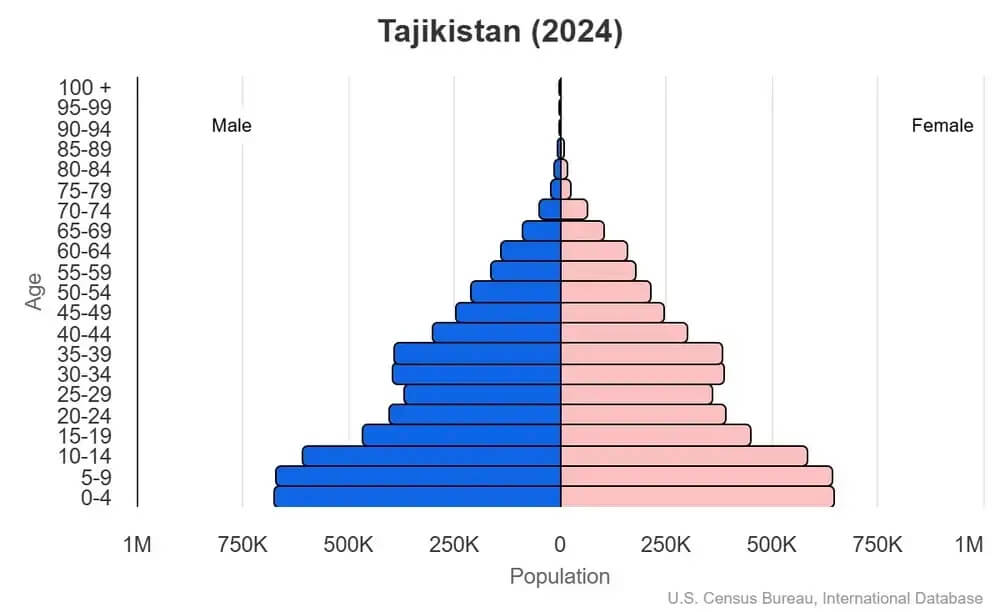
Total: 10,394,063 (2024 estimated)
Ethnic groups
Tajik 84.3% (includes Pamiri and Yagnobi), Uzbek 13.8%, other 2% (includes Kyrgyz, Russian, Turkmen, Tatar, Arab) (2014 estimated)
Languages
Tajik (official) 84.4%, Uzbek 11.9%, Kyrgyz 0.8%, Russian 0.5%, other 2.4% (2010 estimated)
Religions
Muslim 98% (Sunni 95%, Shia 3%) other 2% (2014 estimated)
Population growth rate
1.92% (2024 estimated)
Tajikistan's population reflects a diverse tapestry of ethnicities, with Tajiks constituting the majority at 84.3%. The presence of Uzbeks and other ethnic groups adds to the cultural richness of the nation. The official language, Tajik, is spoken by the vast majority, while Uzbek and Russian also hold significance in various regions. The population is predominantly Muslim, with Sunni Islam being the most practiced faith. The country has experienced a notable population growth rate of 1.92%, indicating a youthful demographic that presents both opportunities and challenges for development. As Tajikistan continues to evolve, the interplay of its ethnic diversity and religious practices will remain central to its social fabric.
Government
Government type
Presidential republic
Capital
Name: Dushanbe
Executive branch
Chief of state: President Emomali RAHMON (since 16 November 1994; head of state and Supreme Assembly Chairman since 20 November 1992)
Head of government: Prime Minister Qohir RASULZODA (since 23 November 2013)
Diplomatic representation in the US
Chief of mission: Ambassador Farrukh HAMRALIZODA (since 17 February 2021)
Diplomatic representation from the US
Chief of mission: Ambassador Manuel P. MICALLER Jr. (since 9 March 2023)
Tajikistan operates as a presidential republic, where the President holds significant authority over the executive branch. The current President, Emomali Rahmon, has been in power since 1994, reflecting a long-standing leadership that has shaped the country's political landscape. The Prime Minister, Qohir Rasulzoda, supports the President in governance. The capital city, Dushanbe, serves as the political and administrative center, playing a vital role in the country's governance and international relations. Tajikistan's diplomatic engagements, particularly with the United States, are facilitated by its ambassadors, who represent the nation's interests abroad.
Economy
Economic overview
Lower middle-income Central Asian economy; key gold, cotton, and aluminum exporter; declining poverty; sustained high growth; very limited private sector; substantial illicit drug trade; significant remittances; environmentally fragile
Real GDP (purchasing power parity)
$50.37 billion (2024 estimated)
$46.467 billion (2023 estimated)
$42.905 billion (2022 estimated)
Real GDP per capita
$4,800 (2024 estimated)
$4,500 (2023 estimated)
$4,200 (2022 estimated)
Exports
$1.618 billion (2024 estimated)
$2.105 billion (2023 estimated)
$1.753 billion (2022 estimated)
Exports - partners
Switzerland 31%, Kazakhstan 18%, China 17%, Uzbekistan 10%, Turkey 8% (2023)
Exports - commodities
Gold, precious metal ore, aluminum, lead ore, antimony (2023)
Imports
$6.907 billion (2024 estimated)
$5.931 billion (2023 estimated)
$5.261 billion (2022 estimated)
Imports - partners
China 57%, Kazakhstan 13%, Uzbekistan 8%, Turkey 6%, UAE 4% (2023)
Imports - commodities
Garments, footwear, cars, wheat, vehicle parts/accessories (2023)
Tajikistan's economy is classified as a lower middle-income economy, characterized by its reliance on key exports such as gold, cotton, and aluminum. The nation has made strides in reducing poverty levels and has experienced sustained economic growth, although the private sector remains limited. The illicit drug trade poses challenges to economic stability, while remittances from Tajik citizens working abroad significantly contribute to the national income. The real GDP, measured in purchasing power parity, is projected to reach $50.37 billion in 2024, with a corresponding GDP per capita of $4,800. The trade dynamics reveal a heavy reliance on imports, particularly from China, which accounts for 57% of total imports, highlighting the need for diversification in trade partnerships and economic activities. As Tajikistan navigates its economic landscape, addressing environmental fragility will be crucial for sustainable development.
Human Development Index
The country's Human Development Index (HDI) is 0.691, ranking it 128th out of 193 countries tested. (more information)
World Happiness Report
The World Happiness Report ranked the country 93rd out of 158 countries tested with a score of 5.281. (more information)