World Book
Bolivia
World Book Index
65

With a score of 65, the country is ranked 83rd out of 158 countries in the World Book ranking. (more information)
Introduction
Bolivia, named after independence fighter Simon BOLIVAR, broke away from Spanish rule in 1825. Much of its subsequent history has consisted of a series of coups and countercoups, with the last coup occurring in 1978. Democratic civilian rule was established in 1982.
Neighboring countries
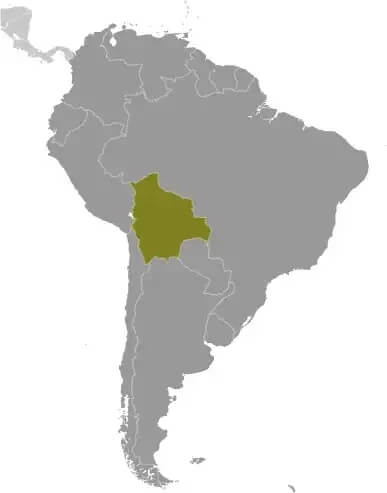
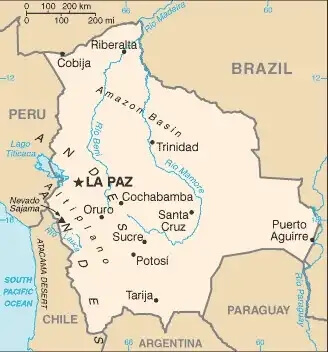
Argentina - Brazil - Chile - Paraguay - Peru
Geography
Area
total: 1,098,581 sq km
land: 1,083,301 sq km
water: 15,280 sq km
Climate
varies with altitude; humid and tropical to cold and semiarid
Natural resources
lithium, tin, natural gas, petroleum, zinc, tungsten, antimony, silver, iron, lead, gold, timber, hydropower
People and Society
Population
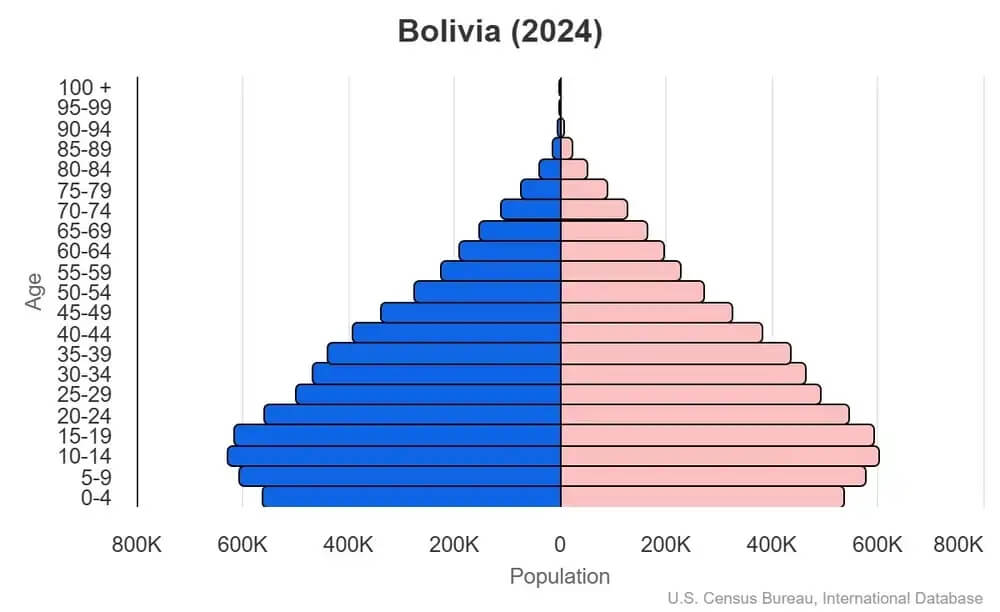
total: 12,311,974 (2024 est.)
Ethnic groups
Mestizo (mixed White and Indigenous ancestry) 68%, Indigenous 20%, White 5%, Cholo/Chola 2%, African descent 1%, other 1%, unspecified 3%; 44% other Indigenous group, predominantly Quechua or Aymara (2009 est.)
Languages
Spanish (official) 68.1%, Quechua (official) 17.2%, Aymara (official) 10.5%, Guarani (official) 0.6%, other 1.5%, unspecified 2.1%; note - Spanish and all Indigenous languages are official (2012 est.)
Religions
Roman Catholic 65%, Protestant 19.6% (Evangelical (non-specific) 11.9%, Evangelical Baptist 2.1%, Evangelical Pentecostal 1.8%, Evangelical Methodist 0.7%, Adventist 2.8%, Protestant (non-specific) 0.3%), Believer (not belonging to the church) 0.9%, other 4.8%, atheist 1.7%, agnostic 0.6%, none 6.1%, unspecified 1.3% (2023 est.)
Population growth rate
1% (2024 est.)
Government
Government type
presidential republic
Capital
name: La Paz (administrative capital); Sucre (constitutional [legislative and judicial] capital)
Executive branch
chief of state: President Luis Alberto ARCE Catacora (since 8 November 2020)
head of government: President Luis Alberto ARCE Catacora (since 8 November 2020)
Diplomatic representation in the US
chief of mission: Ambassador (vacant); Chargé d'Affaires Henry BALDELOMAR CHÁVEZ (since 11 October 2023)
Diplomatic representation from the US
chief of mission: Ambassador (vacant); Chargé d'Affaires Debra HEVIA (since September 2023)
Economy
Economic overview
resource-rich economy benefits during commodity booms; has bestowed juridical rights to Mother Earth, impacting extraction industries; increasing Chinese lithium mining trade relations; hard hit by COVID-19; increased fiscal spending amid poverty increases; rampant banking and finance corruption
Real GDP (purchasing power parity)
$122.2 billion (2024 est.)
$120.531 billion (2023 est.)
$116.927 billion (2022 est.)
Real GDP per capita
$9,800 (2024 est.)
$9,800 (2023 est.)
$9,700 (2022 est.)
Exports
$11.905 billion (2023 est.)
$14.465 billion (2022 est.)
$11.594 billion (2021 est.)
Exports - partners
Brazil 15%, India 13%, China 11%, Argentina 11%, UAE 8% (2023)
Exports - commodities
gold, natural gas, precious metal ore, zinc ore, soybean meal (2023)
Imports
$12.988 billion (2023 est.)
$13.462 billion (2022 est.)
$10.187 billion (2021 est.)
Imports - partners
China 22%, Brazil 18%, Chile 13%, USA 7%, Peru 5% (2023)
Imports - commodities
refined petroleum, cars, pesticides, trucks, plastics (2023)
Human Development Index
The country's Human Development Index (HDI) is 0.733, ranking it 108th out of 193 countries tested. (more information)
World Happiness Report
The World Happiness Report ranked the country 77th out of 158 countries tested with a score of 5.784. (more information)